

In this guide
Here is a thing that happens in almost every new home in Kuala Lumpur. You get the keys. The cabinets are new, the tiles are spotless, the appliances still have plastic film on them. You move your furniture in. And then, a few weeks later, you find yourself standing in the middle of it thinking — why does this not feel like anything?
It is rarely the furniture. It is almost never the budget. In our experience it is nearly always the same five or six decisions, made quickly in the first fortnight, in the same rooms, by almost everybody. So let's walk through the house.
The short version
The same five or six decisions go wrong in almost every new home in Kuala Lumpur — in the same rooms, made quickly, in the first fortnight.
- The living room usually fails on furniture scale, not furniture choice.
- A new kitchen feels cold because nothing in it is warm, worn or open.
- If a room is not working, check the layout before you buy anything else.
The living room, and the wall
Start where everyone starts: the sofa goes against the wall. Of course it does. The room is small, the sofa is the biggest thing you own, and pushing it flat against the plaster feels like the responsible thing to do with the space.
Try pulling it off the wall. Fifteen or twenty centimetres is enough. That sliver of air behind the back cushions is the difference between a room that reads as arranged and a room that reads as crammed — and in a lot of KL condos, the gap is exactly where a slim console ends up living, or a plant, or somewhere to put a coffee cup down.

Then look down. The most common small-living-room mistake we see is a rug the size of a bath mat, marooned under the coffee table. A rug is supposed to gather the furniture, not sit apart from it — every seat in the group should have at least its front legs on it. Size up, always. Jute or a low wool pile, in something close to the floor tone if you want the room to feel bigger.
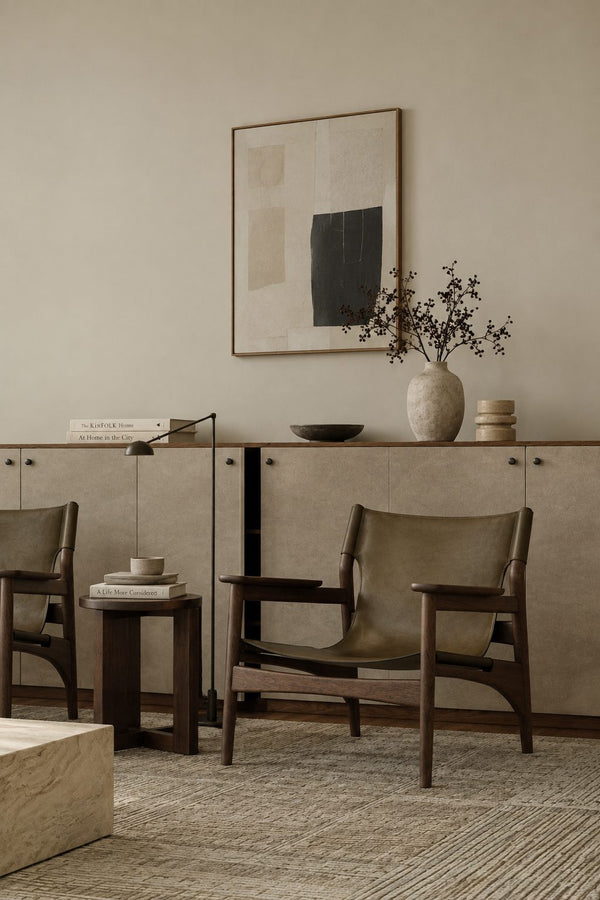
And look up, because wall space in Malaysian condos is criminally underused. A tall narrow shelf holds what a wide low one holds and gives you back the floor. It is also where a room starts to feel collected rather than furnished — a shelf of things you actually picked up somewhere, stacked a bit unevenly, reads as a home with a history. A shelf styled to a grid reads as a showroom.
The lighting rule that fixes most rooms. If your living room runs off one central downlight, it will always feel a little clinical, whatever you put in it. Add a floor lamp and a table lamp on warm bulbs, then turn the ceiling light off in the evening. Warmth is usually not a colour decision. It is a wattage and a height decision.
The kitchen that looks new and feels cold
Walk through to the kitchen and the problem changes shape. Nothing is wrong with it. That is the problem.

Most new condo kitchens here are handed over in laminate, quartz and stainless steel — every surface cool-toned, reflective, and hard. There is nothing in the room your eye can rest on. The fix is not a renovation. It is one timber chopping board left out on the counter, a rattan basket for onions and garlic, a runner in a natural fibre. Small interruptions in all that sheen.
Swap one run of upper cabinets for open shelving, too, and put the things you actually reach for on it — the glassware, the good bowls, the coffee kit. Every extra bank of closed doors makes a small kitchen feel more like storage and less like a room. And let a few things be old. One inherited ceramic jar or a cast-iron pan you genuinely use, sitting beside brand-new fittings, does more for warmth than a whole set of matching new accessories.
Old and new, mixed on purpose, is what stops a kitchen reading as a display case and starts making it read as yours.
One more, and it is the cheapest thing in this article: put light under the cabinets, not only above them. A ceiling downlight throws shadow exactly where you are chopping. Under-cabinet lighting costs very little and changes how the whole room feels after dark.
When it is all one room
Increasingly in KL it is not three rooms at all. The wall between kitchen, dining and living came down before you ever saw the place, and you would expect that to feel bigger. Sometimes it does. Just as often it feels like one undefined room instead of three connected ones, with furniture floating and nothing telling you where you are.

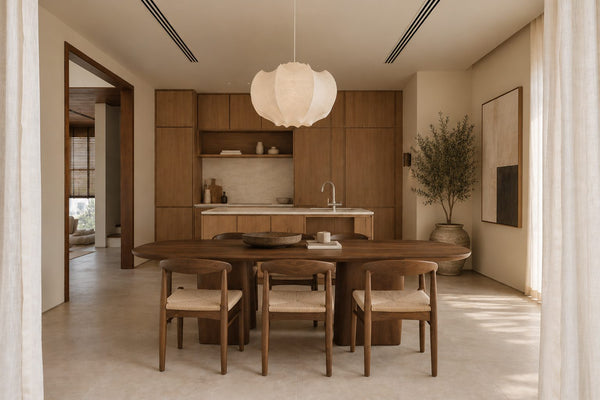
Without walls, the rug does the job the wall used to do. Size it generously under the whole seating group and let the dining table sit on its own or on bare floor, so the floor itself tells you where the living room ends.
Then run one material thread through the space — a wood tone, a metal finish, a colour that appears in more than one zone without every piece matching. A dining chair leg and a console in the same timber; brass in the kitchen and again in the living area. A thread, not a uniform.
And light each zone for what happens in it. A pendant over the table, a floor lamp in the living corner, task light in the kitchen. Identical lighting everywhere is the single biggest tell that an open-plan space was never really planned — different light for different activities separates the zones more effectively than any furniture arrangement can.
The bedroom you keep not sleeping in
Most bedroom advice is about how the room looks. This one is about how it works, because a bedroom that photographs beautifully and a bedroom you sleep well in are not automatically the same room.

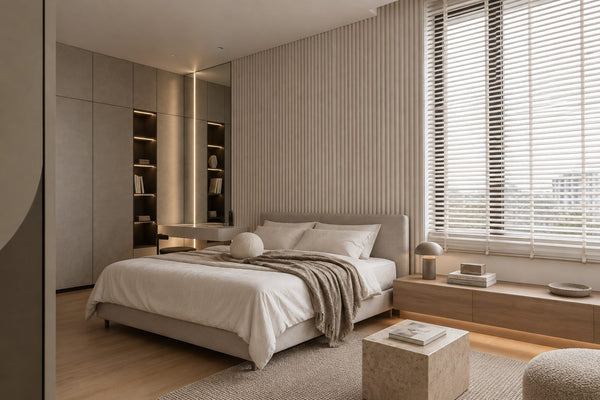
The overhead light is the culprit again. A single bright ceiling fixture at eleven at night is the wrong light to wind down under, and it is still how most condo bedrooms are wired. Two bedside lamps on warm bulbs, low and easy to switch off without standing up, will do more for your sleep than anything else on this list.
Then stop matching your furniture and start matching your textiles. A bedroom where the frame, side tables and wardrobe all came from the same set reads like a hotel room. Let the furniture be a little mismatched — an inherited side table beside a new bedframe — and let the linens, the throw and the cushions tie the room together instead. It is the cheaper fix and the one that looks more considered.
The nightstand test. Look at what is on yours right now. If it is a phone charger and nothing else, the room is not set up for how you actually wind down. A lamp, a small dish for rings and glasses, a book you are halfway through. Small real things, rather than staged ones.
And in this city, blackout is not optional. Between street light, neighbouring towers and a sunrise that arrives early all year, a sheer-only curtain is one of the most common reasons a beautiful bedroom still is not a restful one. Layer a blackout lining behind whatever curtain you love the look of.
Sleeping cool, which is its own problem here
Heat is the other half of it. Choose bedding in natural, breathable fabrics — pure cotton, linen, silk — which let your skin breathe rather than trapping warmth against it. Layer lightly rather than heavily: a white cotton bedspread works as a blanket on a cooler night and as a top sheet on a hot one.
- Draw the curtains during the day, not just at night — you are blocking heat, not light.
- Crack a window slightly in the evening for a through-draught before the aircon goes on.
- Keep the bed away from the wall that takes the afternoon sun, if the layout allows it.
The bathroom that is trying to be a hotel
Hotel-style is the default reference for almost every bathroom renovation in Malaysia. White tile, glass, chrome, a rain shower. It photographs well. It is also cold and slightly sterile, and rarely anywhere you would want to spend ten unhurried minutes.

You do not need to retile anything. A teak bath mat, a wooden stool, a lidded basket for towels — one or two natural materials against all that glass and tile change the temperature of the room, visually and literally.
Then hide the storage rather than showing it. Open shelving works in a kitchen; in a bathroom it mostly displays your shampoo bottles to everyone who walks in. And put light at face height. A ceiling downlight casts shadow exactly where you are trying to see your own face — sconces either side of the mirror is a small electrical change with an outsized effect.
The mistake that costs the most in a small bathroom is sizing. An oversized vanity, or a shower screen that swings the wrong way, eats the one thing you cannot get back, which is room to move. Measure the swing radius of every door and screen before you commit to a layout. It is the detail skipped most often.
When it is not a styling problem
Everything above is fixable in an afternoon or a weekend, and most of it costs very little. But sometimes the room really is the problem — a wardrobe eating the floor, a kitchen triangle that fights you every time you cook, plumbing in the wrong place, storage that does not fit how you actually live.
That is a design conversation rather than a styling one, and the honest signal is repetition: if you have rearranged the same room three times and it still is not right, no amount of cushions will settle it.
Where to see this in practice
If you are working on one of these rooms rather than reading about all of them, here is where our own work sits:
- Our Portfolio — the same rooms, finished: living rooms, kitchens and bedrooms, organised by room
- Interior Styling — for the rooms above that are a styling problem, worked around the furniture you already have
- Interior Design — for the last section: when it is not a styling problem and the layout itself has to change
Notes & further reading
This piece reflects ongoing work across Kuala Lumpur and Selangor.
About Angelica Lee
Chief Home Maker and founder of Sundays in Bed, award-winning interior designer. Learn more about Angelica →

Your rooms
Not sure which one yours is?A few questions about your home, and a personalised estimate in your inbox.
- Your rooms
- Its condition
- Finish level
Two minutes. No obligation, and no call required.
If you would rather read first: interior styling versus interior design sets out which of the two your home actually needs, and what interior design costs in KL and Selangor covers the numbers, including the renovation works.