

In this guide
Every December, beautiful rooms are asked to become something else.
The art begins competing with wreaths. A carefully considered sideboard disappears beneath decorations. The palette that worked all year suddenly acquires several unrelated shades of red, green, gold and silver.
It can certainly feel festive.
It does not always feel like the same home.
Christmas decorating works better when it begins with what is already there: the colour of the room, the height of the ceiling, the timber and stone setting its tone, the art you do not want to hide, the table everyone will actually gather around.
The objective is not a restrained Christmas for the sake of restraint. Abundance can be wonderful. So can colour, nostalgia and decorations that have absolutely no interest in matching the sofa.
The difference is intention.
Christmas should arrive in your home. Your home should not disappear beneath Christmas.
Let Christmas respond to the house
The easiest place to begin is not with a Christmas theme.
Begin with the room.
A home with walnut, olive upholstery and warm stone already has a language. Evergreen foliage, aged brass, burgundy ribbon and warm white lights might sit naturally within it.
A lighter apartment with pale stone, contemporary art and cooler blue-grey upholstery may want something quieter: glass, silver, dark green branches or a deeper blue that already exists elsewhere in the room.
Neither approach is more festive.
The point is that the seasonal layer should feel as though it grew out of the home rather than landed on top of it.
This is why copying a complete Christmas “look” from somewhere else can feel strangely artificial once it reaches your own living room. The architecture is different. The light is different. The artwork is different. The furniture is already telling another story.
Use those things.
Pull a colour from a painting rather than from a trend report. Let the timber in the room determine whether the metallic accents feel better in brass, silver or something darker. If the home is already rich in colour, perhaps the greenery and light are enough.
The most considered festive interiors do not require every object to announce Christmas.
They allow the existing home to do some of the work.
One generous gesture is better than twenty small ones
Festive decorating has a tendency to fragment.
A miniature tree on one console. Three ornaments on another. Small wreaths. Little houses. A bowl of baubles. More decorations filling the spaces between them.
None is necessarily wrong.
But scattered decoration can make even a generous room feel visually smaller.
Scale usually creates more impact than quantity.
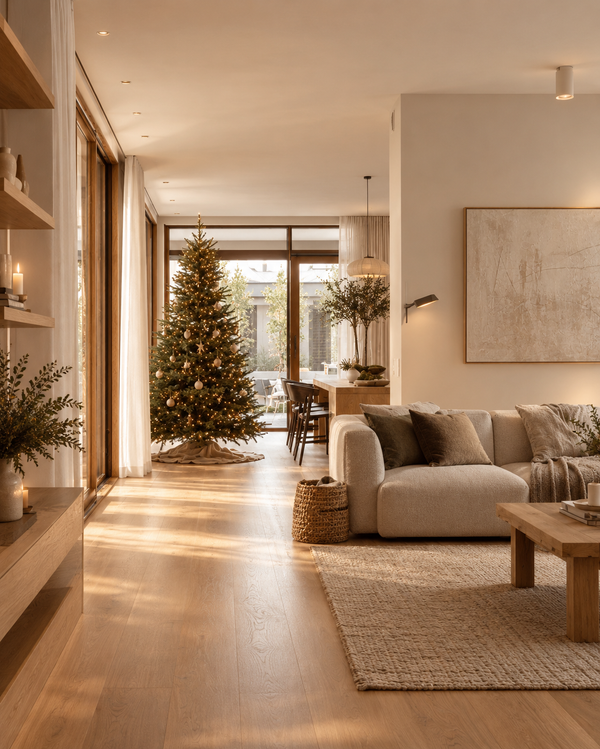
A well-proportioned tree with enough space around it can carry an entire living room. A substantial arrangement of branches in one vessel can do more for an entrance than several small festive objects. One full garland can feel more convincing than a series of smaller gestures competing along the same sightline.
In a condominium, proportion matters just as much. Tree diameter can matter more than height if it interrupts the route between the living and dining areas. A beautiful tree that forces everyone to squeeze around the sofa is not beautifully placed.
In a larger landed home, the opposite can happen: a tree chosen too cautiously can disappear beneath a tall ceiling or inside a generous open-plan room.
Abundance and clutter are not the same thing.
The aim is not to use less because less is automatically more sophisticated.
It is to use enough scale that the decorations feel deliberate.
One generous gesture often feels more luxurious than twenty small decorations.
Christmas in Malaysia begins after sunset
Much of the Christmas imagery we absorb comes from places where December light disappears in the middle of the afternoon.
Kuala Lumpur does not have that four-o'clock winter darkness.
Here, the room may still be bright and tropical late in the day, then change character quite quickly once the sun goes down.
That makes lighting one of the most useful festive tools.
A room can look beautifully decorated at 3pm and completely flat at 8pm if the only evening light comes from a ceiling full of downlights.
The tree helps, but it should not carry the entire room.

Turn down the overhead lighting where possible. Bring table and floor lamps into the corners where people actually sit. Let the dining table have its own softer pool of light. Candles, used safely, can bring movement and intimacy that electric light cannot quite replicate.
The aim is contrast.
Some parts of the room can recede. Others can glow.
Timber becomes richer. Glass catches small points of light. Metallic details begin to register without needing to be everywhere. Greenery that seemed ordinary during the day gains depth.
This is particularly useful if you prefer a quieter Christmas palette. Warm light can create most of the atmosphere without asking the room to absorb more decoration.
The table is still about the people sitting around it
The dining table is one place where a little ceremony feels right.
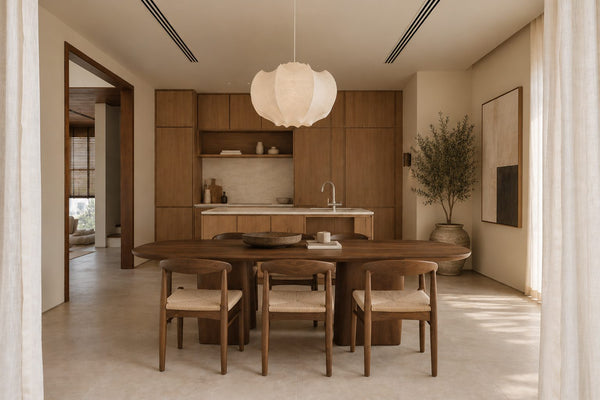
Bring out the linen you rarely use. Mix the glassware. Use the serving dish that appears every December. Add foliage, flowers, candles or a runner that changes the mood without covering the table entirely.
But the centrepiece should not become the guest everyone has to talk around.

A low arrangement can feel more generous than a tall one because people can still see one another. A few candles at different heights can create rhythm without taking over the surface. Beautiful plates and glassware deserve room to register without another decorative object squeezed into every gap.
And leave somewhere for the food.
It sounds obvious until the table has been styled so thoroughly that dinner has nowhere to land.
The point of the table is still the people sitting around it.
The best festive tables are often the ones that loosen as the evening continues. Napkins move. Serving dishes arrive. Glasses gather. Someone pulls another chair across.
A table that only looks good before anybody sits down has misunderstood the assignment.
The decorations worth keeping rarely came as a complete set
There is a version of Christmas styling in which everything is new and perfectly coordinated.
It photographs beautifully.
It can also remove the very thing that makes Christmas personal.
The ornament bought on a trip fifteen years ago. Something made by a child. A slightly faded decoration inherited from a parent. The serving platter used every year. A box of objects that would never have been selected together but somehow belong together because they have appeared in the same home every December.
Keep them.
A beautifully styled Christmas should still contain something no stylist could have bought for you.
The personal things do not need to dictate the whole room. Give them context instead.
Older ornaments can sit among a quieter new palette. A sentimental object can have its own place rather than disappearing into a crowded display. Family pieces can be concentrated on the tree while other parts of the home remain more restrained.
This is where a home begins to feel festive rather than themed.
Perfection is not what people remember about Christmas.
Recognition is.
The decoration that always appears in the entrance. The smell of something cooking. The glassware your family has used for years. The chair someone always takes after dinner.
A well-styled home makes space for those rituals rather than replacing them with a more photogenic version.
Sometimes festive styling begins by putting something away
Before Christmas enters the room, edit the room itself.
This does not mean stripping it bare.
It means giving the seasonal layer somewhere to go.
A console already carrying six decorative objects may not need six more Christmas objects. Put a few everyday pieces away for December and let one arrangement have the space instead.
If the tree needs the best corner of the room, move the occasional chair rather than wedging the tree beside it. Shift the floor lamp so it works with the new layout. Clear the dining sideboard before adding greenery or candles. Let the art remain visible rather than trying to decorate every wall around it.
This is where Christmas decorating starts to overlap with interior styling.
The question becomes less about ornaments and more about the room: scale, furniture placement, lighting, sightlines, colour and how everything works together once more people arrive.
You do not need a professional to hang a wreath.
But if you want the entrance, living room, tree and dining area to feel connected — or you already own beautiful decorations and never quite know how to bring them together — a stylist can help create the seasonal layer without losing the home underneath it.
At Sundays in Bed, our Interior Styling work normally begins with the furniture, art and pieces a client already owns, then looks at placement, lighting, textiles and the additions genuinely worth making. The same principle applies beautifully to a festive room: start with what is already good, then add with intention.
If you would like help specifically with festive styling, speak to us about what you have in mind and we can work out whether it is something we can support alongside the room itself.
The house should still feel like yours on December 26
The most successful Christmas homes are not necessarily the ones with the largest trees or the most elaborate decorations.
They are the ones where the season seems to belong.
The tree has enough presence to change the room without compromising it. The evening light makes everyone want to stay at the table a little longer. Familiar decorations live comfortably beside newer ones. There is colour and generosity without every surface asking for attention.
Most importantly, the home underneath it all remains visible.
Because Christmas is temporary.
Your relationship with the room is not.
Decorate generously if that is what you love. Use colour. Keep the ridiculous ornament that makes everyone laugh. Fill the dining table when people arrive.
Just let the home participate too.
The best festive rooms do not feel like somewhere else for a month.
They feel like your home at Christmas.

The first conversation
Making the house feel special this Christmas?Show us the rooms you are decorating, what you already own and how you usually celebrate.
- The rooms
- What you own
- How you celebrate
For homes in Kuala Lumpur and Selangor. Get in touch to discuss the level of styling support you need.
About Angelica Lee
Chief Home Maker and founder of Sundays in Bed, award-winning interior designer. Learn more about Angelica →