

In this guide
You bought the sofa carefully.
The dining table was worth waiting for. The curtains are up. The television is mounted. There is art on the walls and enough furniture that nobody could reasonably call the room empty.
And yet it still feels unfinished.
Nothing is obviously wrong, which is what makes the feeling difficult to explain. The room may be attractive. The individual pieces may be good. You may even have spent considerably more than you expected.
But something has not settled.
Often, the answer is not more furniture. It is not a renovation either.
The rug may be slightly too small. The artwork may be hanging without any real relationship to the furniture below it. The armchair may be in the only place it has ever been, rather than the place where it makes the room work best. Every light may come from the ceiling. The objects you love may be scattered rather than given somewhere to belong.
Individually, these are small decisions.
Together, they are the difference between a room that has been furnished and one that feels finished.
A furnished room contains everything it needs. A finished room knows why everything is there.

Good furniture does not automatically make a finished room
A room can contain very good things and still lack a point of view.
That is because we experience a room as a whole, not as a catalogue of individual purchases.
The sofa may be beautiful but too visually heavy for the chair opposite it. A sideboard may be perfectly made but too narrow for the wall. A rug may be expensive and still make the seating group look as though it is floating. A painting may be meaningful but lose its presence because it is hung too high or surrounded by too many smaller objects competing for attention.
None of these problems necessarily calls for replacement.
They call for relationship.
That is one reason interiors often feel most unresolved after the large purchases are complete. The big pieces answer practical questions — where to sit, where to eat, where to store things — but they do not automatically create rhythm, hierarchy or atmosphere.
A room begins to settle when the pieces start responding to one another.
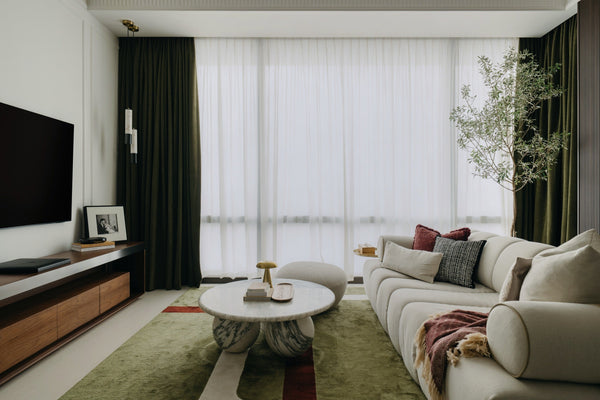
The rug gathers the seating rather than sitting beneath part of it. The lamp gives a darker corner a reason to exist. The art relates to the furniture without matching it. Curtains soften a large window and make its scale feel intentional. A side table appears exactly where someone naturally reaches for a glass.
These details are quieter than a new sofa.
They are also often the details that make the sofa finally look right.
Before buying anything, move what you already own
The instinct when a room feels incomplete is to shop.
Another chair. A larger artwork. A console. More cushions. A new lamp because the existing one has never looked quite right.
Sometimes those things are needed.
But the first styling decision should often happen before anything new enters the room.
Move the armchair closer to the sofa and suddenly there is a conversation rather than two separate seating areas. Rotate the dining table and the route to the balcony opens up. Move the sideboard to the longer wall and the artwork above it finally has enough space. Shift the rug twenty centimetres and the entire seating group feels more anchored.
Or remove something.
The lamp that was added because the corner looked empty may be the reason the corner feels busy. Six small objects across a long console may have less presence than two pieces with enough space around them. Artwork inherited from a previous layout may belong beautifully in another room.
The first styling decision is often not what to add. It is what to move.
This is where familiarity can work against us.
Live with a room for long enough and the furniture starts to feel fixed. The chair is there because it has always been there. The artwork stays on that wall because the hook already exists. The console appears immovable even though nobody can quite remember why it went there in the first place.
A fresh pair of eyes does not carry those assumptions.
That is often the first real value of styling: seeing possibilities in a room that the person living there has stopped seeing.
The invisible things that make a room settle
The final layer is not simply decorative.
It is a series of small adjustments to proportion, light, art and material that change how the room holds together.
Proportion
Most rooms do not announce that their proportions are wrong. They simply feel less settled than they should.
A rug that stops just short of the front legs of the sofa makes the furniture appear disconnected. A tiny lamp on a generous sideboard can make both pieces feel strangely uncertain. A narrow artwork above a long sofa may leave the wall looking unfinished even when the artwork itself is beautiful.
The solution is not always to make everything larger.
It is to understand the relationship.
A small work can have enormous presence when it is given enough wall around it. A compact chair can balance a substantial sofa if its shape has enough visual weight. A delicate console can work in a large room when the objects and art around it are scaled deliberately.
Proportion is not a rulebook.
It is what allows the room to feel confident.

Light
A room can feel perfectly pleasant at three in the afternoon and strangely flat at eight in the evening.
Often, the missing layer is not another object but another source of light.
A table lamp beside the sofa. A floor lamp making a reading chair useful. A lower pool of light on a console. A warm lamp in the corner that would otherwise disappear once the ceiling lights are dimmed.
Good evening lighting gives a room depth because not every surface is equally bright.
It also changes how materials feel. Timber becomes richer. Linen appears softer. Art gains contrast. Corners that looked incidental during the day become places people want to sit.
Art
Art can make a room personal faster than almost anything else.
It can also make a room feel oddly generic when it has been chosen only because the colours match the cushions.
The most convincing art does not need to repeat the palette perfectly. It needs a reason to be there: because you found it while travelling, because the artist matters to you, because it makes you feel something, or simply because you have never become tired of looking at it.
Styling helps the work belong to the room without asking it to become decoration.
Sometimes that means changing the height. Sometimes it means moving it to a quieter wall. Sometimes it means putting two pieces together and giving them more space. Sometimes the best decision is leaving a wall empty.
Texture
Texture is what stops a finished room from feeling overly polished.
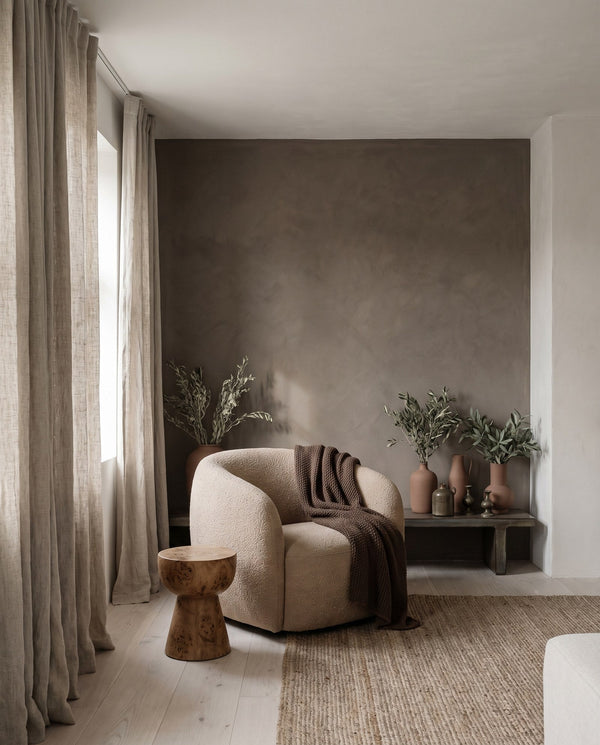
A woven rug against smooth timber. Linen curtains beside a painted wall. Books breaking up the precision of joinery. A ceramic object next to metal. Something old beside something new.
But layering is not the same as accumulating.
The aim is not to introduce every texture available. It is to create enough variation that the room rewards a closer look.
The hardest part of styling is knowing when to stop
There is a point in almost every room where another purchase makes it worse.
That point is difficult to recognise because unfinished surfaces create temptation. An empty console seems to ask for another object. A blank wall suggests another picture. An open corner looks like somewhere furniture should go.
But a room needs quiet as much as it needs interest.
A large painting becomes more meaningful when the wall around it is allowed to remain calm. A beautiful timber cabinet has more presence when it is not covered from edge to edge. A favourite chair can hold an entire corner when it is given light, a small table and enough room to breathe.
Restraint is not minimalism for its own sake.
It is what makes personality legible.
This matters particularly in homes where the owner has already collected good things. Books, art, ceramics, photographs, objects brought back from travel, inherited furniture — they do not need to be replaced by a perfectly coordinated set of accessories.
They need editing.
Group rather than scatter. Give meaningful objects more space. Remove the things that were bought merely to fill a gap. Let some surfaces remain almost empty.
A stylist should know when the room needs one more thing.
They should also know when it needs five fewer.

Sometimes what you are paying for is another pair of eyes
Professional styling can sound deceptively simple because much of the work happens without demolition, dust or technical drawings.
But the absence of construction does not mean the absence of judgement.
A stylist has to see the room at several scales at once.
The overall balance of furniture. The relationship between art and architecture. The way the room reads from the entrance. The height of a lamp beside a chair. The material that is missing. The thing that should be removed. The corner everyone has stopped noticing.
Most importantly, they have to understand the difference between a room that needs more and a room that simply needs to be reconsidered.
That is difficult to do in your own home because you know it too well.
You have already adapted to the walkway around the chair. You stopped noticing the art is slightly too high. You assume the sideboard belongs on that wall because that is where the movers placed it three years ago.
A professional eye arrives without that history, but with an understanding of proportion, placement, lighting, colour and materiality.
Sometimes what you are paying for is not another pair of hands. It is another pair of eyes.
At Sundays in Bed, Interior Styling begins with what is already there. Existing furniture and pieces that matter stay at the centre of the plan; we first look at how they can be repositioned or reworked before recommending anything new. Where something is missing, the additional layer might be art, lighting, textiles or a carefully chosen piece rather than an entirely new room. The service then carries through to placement and styling so the decisions are considered together rather than purchased one by one.
The aim is not to make your home look newly decorated.
It is to make it feel as though everything finally found its place.
The room should feel settled, not styled
The best-styled rooms do not constantly remind you that someone has styled them.
The lamp is simply where you want it when the evening gets darker. The chair finally has a relationship with the sofa. The rug quietly gathers the furniture. The art feels as though the wall was always waiting for it.
The objects you care about have enough room around them to be noticed.
There is personality, but no performance.
There is enough detail to make the room feel lived in and enough restraint that it can continue changing with you.
Nothing is calling for attention.
The room simply feels settled.
And often, that is what people have been trying to buy all along.

The first conversation
Does your room feel nearly there?You may not need to start again. Show us the room, the pieces you want to keep and what still does not feel quite right.
- The room
- What is staying
- What feels wrong
Interior Styling for homes in Kuala Lumpur and Selangor.
About Angelica Lee
Chief Home Maker and founder of Sundays in Bed, award-winning interior designer. Learn more about Angelica →